Do You Really Need to Open the Wall for a Bad Flush?
Toilet flushing poorly and someone mentioned opening the wall? Here’s how we diagnose bad flushes, when wall access is truly needed, and when it’s not.
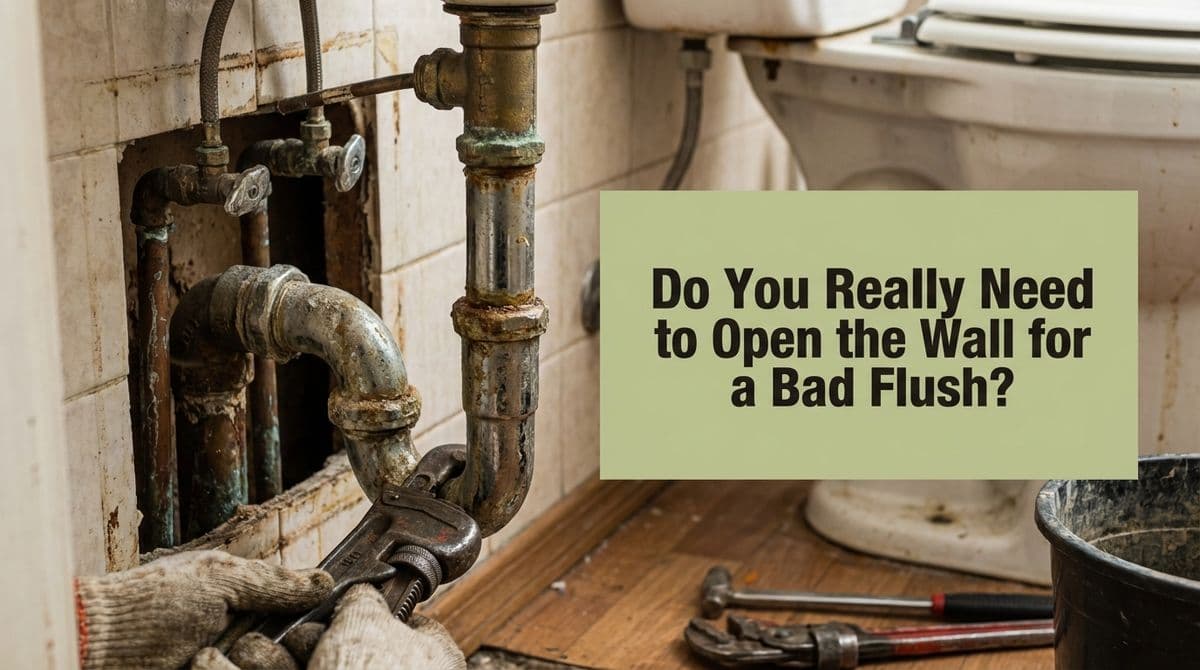
When a “Simple” Toilet Trap Becomes a Big Job
We recently got a call from a customer — let’s call him Tom — who was dealing with a toilet that just wouldn’t flush right. The bowl would fill, swirl a bit, and then… not much. No satisfying whoosh, and sometimes he’d have to flush twice just to clear it.
Tom told us another plumber had been out before and suggested the problem was the old-style toilet trap under the bathroom. The part that really worried him? That plumber said the only way to fix it might be to knock out the wall to get to the piping.
By the time Tom called us, he wasn’t just frustrated with the toilet — he was nervous about turning his bathroom into a construction zone. So we scheduled a visit and walked him through what really has to happen in situations like his.
First Things First: Is the Toilet Itself the Problem?
When we arrive on a job like Tom’s, we never assume we’ll be opening walls or crawling under the house. We start with the simplest, least invasive checks:
- Check the tank level and fill valve – If the water line in the tank is too low, you’ll never get a strong flush.
- Inspect the flapper – A worn or misaligned flapper may close too early, cutting the flush short.
- Look for mineral buildup – Hard water can clog the rim holes and siphon jet, weakening the flush over time.
- Test with a good plunger – Sometimes a partial blockage in the trapway of the toilet can mimic a bigger pipe problem.
More often than homeowners realize, a “bad” flush is caused by one of these straightforward issues — not a failing trap under the floor. In those cases, we can usually fix it on the spot with parts we carry on the truck.
When the Issue Is the Trap — And Why It’s Tricky
In older homes, especially ones that have seen several remodels, you sometimes find an old-style toilet trap or awkward piping layout under or behind the toilet. Instead of the modern toilet design providing the entire trap, the plumbing below can include extra bends, tight turns, or undersized pipe.
Those old setups can cause:
- Slow, weak flushing – Waste doesn’t get enough velocity through the bends.
- Frequent clogs – Paper and solids get hung up on rough or poorly sloped sections.
- Gurgling or partial siphon – Air gets trapped where it shouldn’t, interrupting the flush.
When we suspect a trap or piping problem like this, we’ll usually recommend a closer look — sometimes with a small camera through the toilet flange or nearby clean-out. That lets us see if the issue is right under the toilet, farther down the line, or somewhere completely different.
Do You Really Need to Open the Wall?
This is the big fear most homeowners have, just like Tom: “Are you going to have to tear my bathroom apart?” The honest answer is: sometimes, but not nearly as often as people are told.
Here are the key questions we ask ourselves before recommending any wall opening:
- Is there access from below? In some homes, we can reach the toilet piping from a crawl space or basement and avoid the wall entirely.
- Is there an existing access panel? Sometimes there’s already a panel behind the tub or toilet we can use.
- Can we solve it by resetting or replacing the toilet? A modern, properly sized toilet can sometimes overcome a marginal layout.
- Is the piping truly defective? Only if the pipe is cracked, badly corroded, or badly misrouted do we consider opening the wall.
If we do determine the wall is the only reasonable way to access the problem pipe, we’ll explain exactly where, how big, and why before any cutting starts. No surprises.
The Real Cost and Risks of Unnecessary Wall Opening
Tom was right to be cautious. Opening a bathroom wall just “to see what’s going on” can be an expensive way to guess. Beyond the plumbing work itself, there are real costs and risks to consider:
- Drywall and texture repair – Even a small access hole needs patching, taping, texture, and paint to look right again.
- Tile or finish damage – If the wall is tiled, removing and matching tile can get pricey fast.
- Hidden surprises – Old galvanized pipe, knob-and-tube wiring, or past DIY work can turn a quick repair into a larger project.
- Disruption – You may lose use of that bathroom for part of a day or more, depending on the scope.
That’s why our approach is always: exhaust the simple, non-destructive options first. We’ll only recommend opening a wall when we’re confident it’s necessary and likely to solve the problem, not just explore it.
How We Protect Your Home When Wall Access Is Necessary
On the occasions when we do have to open a wall to reach a toilet trap or waste line, we treat your bathroom like it’s our own. Homeowners are often surprised at how controlled and tidy the process can be when it’s planned out.
Here’s what we typically do to protect your space:
- Cover floors and fixtures – We lay down drop cloths or protective plastic around the work area, and often remove or cover the toilet.
- Dust control – We score the wall, use controlled cutting tools, and clean as we go to keep dust and debris to a minimum.
- Precise opening – We open the smallest area we reasonably can, usually centered on where the piping actually runs.
- Temporary closure – If the wall can’t be fully patched the same day, we make sure the opening is safe and closed off until it’s repaired.
We’ll also walk you through what’s next for patching and painting, whether you want to handle that yourself or bring in a finisher.
What We Tell Homeowners Like Tom
When a customer calls us worried about a poor-flushing toilet and talk of breaking into walls, we keep the game plan simple:
- Start at the toilet – Rule out easy fixes: tank level, flapper, mineral buildup, partial clogs.
- Check the line – If needed, use snakes or a camera to see what’s happening beyond the toilet.
- Evaluate the layout – Only if we see a clear trap or piping defect do we talk about accessing it.
- Explain your options – Repair in place, re-route, or replace fixtures — with clear pros, cons, and costs.
If your toilet never seems to flush quite right and someone has already mentioned opening walls or floors, it’s worth getting a second opinion. Sometimes it really is a big job. But many times, we can get you that strong, reliable flush without turning your bathroom into a remodel project.
If you’re in our service area and dealing with a stubborn toilet, give us a call. We’re happy to take a look, walk you through the options, and only open things up when we truly have to.